
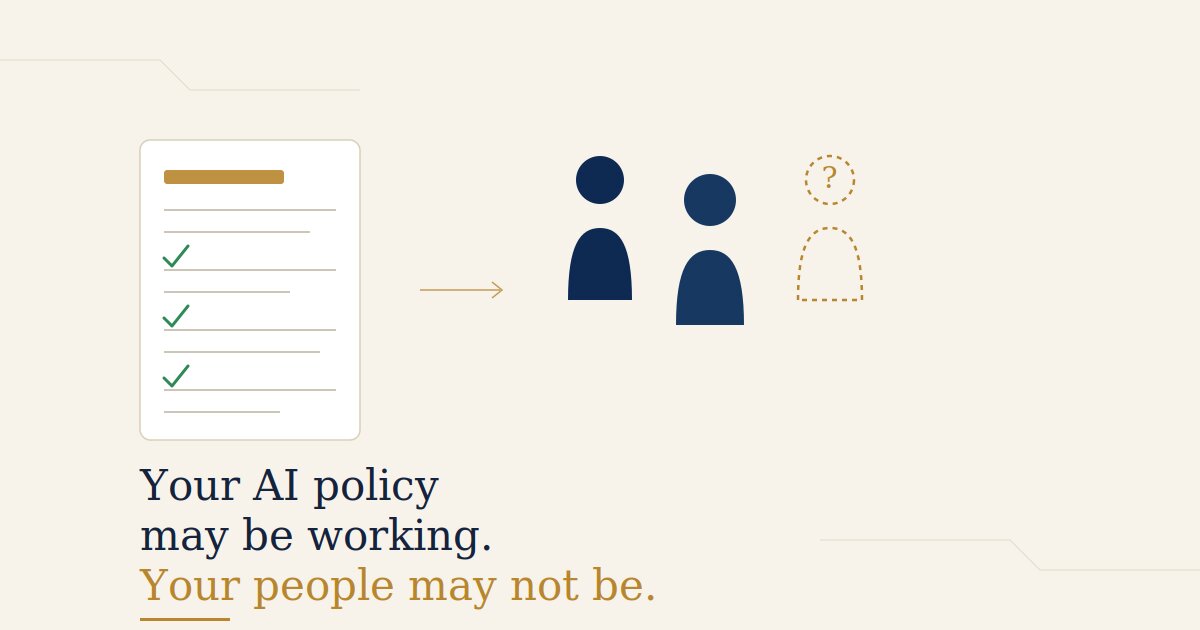
Many financial services firms have moved quickly to establish AI policies, governance frameworks and approval processes.
That's necessary.
But it doesn't answer a more difficult question:
How are people actually behaving?
Most AI-related incidents do not begin with a failure of technology. They begin with ordinary human behaviour.
An employee uses an unapproved tool because it's more convenient.
A manager relies on AI-generated analysis without sufficient challenge.
A team becomes dependent on AI support and gradually loses critical skills.
A colleague starts questioning whether feedback from their manager reflects genuine judgement or an AI-generated summary.
None of these behaviours necessarily breach policy. Yet each can create risk.
The challenge for organisations is that behavioural risks are often invisible until something goes wrong.
Most firms can tell you:
- what their AI policy says;
- what training has been delivered;
- which systems have been approved.
Far fewer can answer:
- whether employees trust AI appropriately;
- whether people challenge AI outputs;
- whether over-reliance is developing;
- whether staff are using unapproved AI tools;
- whether managers understand the behavioural risks emerging within their teams.
As AI becomes embedded in everyday work, understanding behaviour may become just as important as understanding technology.
The question is no longer whether people are using AI.
The question is whether they are using it wisely.
Ready to Showcase Your Training Expertise?
Join our marketplace and connect with organizations actively seeking training solutions. Showcase your expertise and grow your training business with qualified leads.