
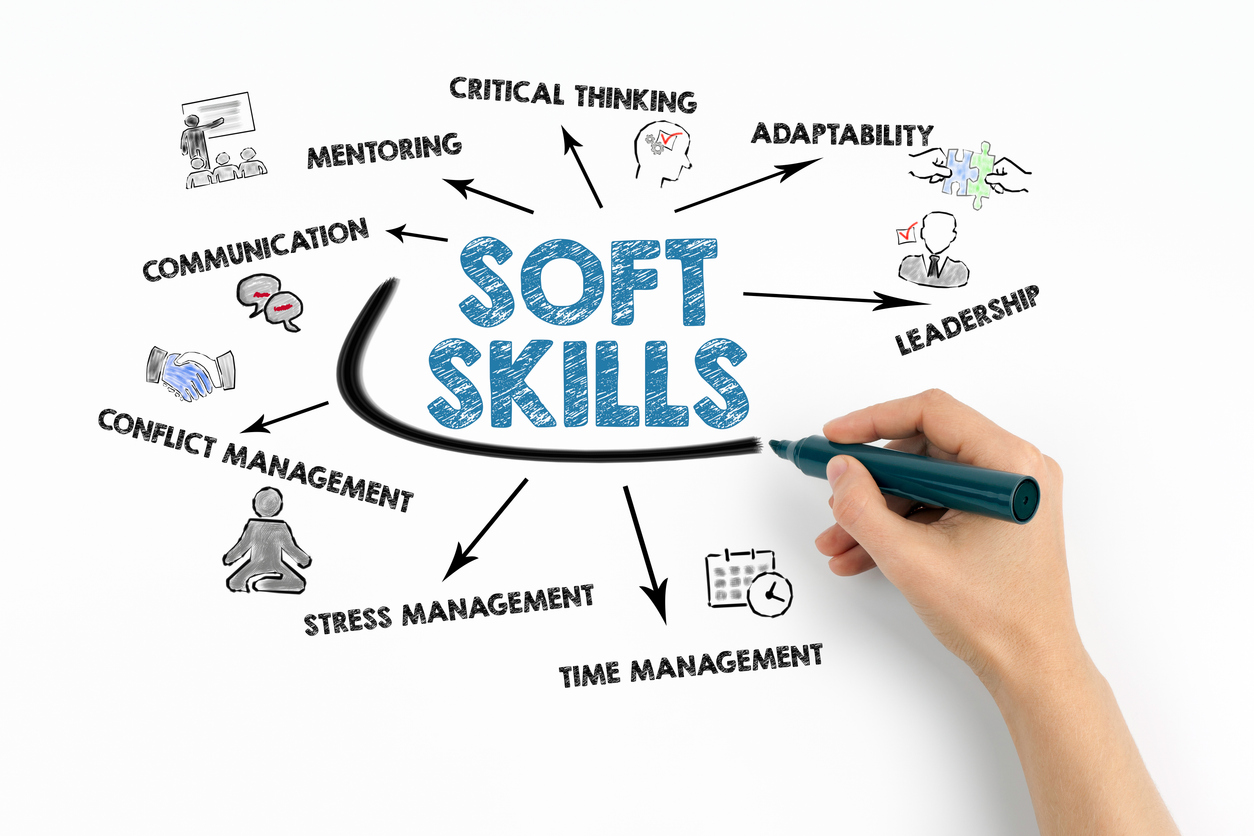
How Soft Skills can future -proof your business
It’s widely recognised that businesses with greater numbers of skilled staff have higher levels of innovation, productivity and profitability. But when considering the specific skills required to operate a successful business, many organisations focus on the hard skills required to make a product or deliver a service. They often neglect the soft skills that are a necessary complement to these hard skills. And do so at their peril.
For sure, it’s essential to employ staff who have the technical or practical competencies that people need to carry out a particular, often complex, task or activity. Think of expertise in carpentry, knowledge of accountancy or proficiency in IT.
But soft skills are just as important. Less tangible than practical skills, they can be harder to nail down. But can be defined as the behavioural, social and communication skills which are essential to modern-day life. Listening to others, getting along with our workmates and being adaptable in the face of change.
Always important, they have taken on a new significance in recent years, for two reasons. Automation and Artificial Intelligence (AI) are rapidly changing the nature of work in manufacturing, distribution, retail and pretty much all other sectors. Transforming how businesses are structured, how they operate and how they communicate with their customers.
This is creating the need for a better-skilled, more rounded workforce capable of performing the complex tasks that robots and AI can’t perform. Often with less supervision and greater autonomy than was the case in more traditional, hierarchical workplaces.
The term ‘soft skill’ encompasses a broad range of proficiencies. What unites them is that they are all, to some extent, personality-driven; are social rather than technical skills; and revolve around interpersonal effectiveness, resilience and work ethic.
1. Communication skills
Good communication skills are essential in many jobs. And can mean the difference between the success or failure of a business. They help staff deal effectively with clients, customers and suppliers, communicate well with team members, and handle difficult situations in the workplace. It’s an art rather than a craft. And requires the recognition that good communication is a two-way process.
2. Collaboration
Collaboration in the workplace is crucial in many fields. The ability to cooperate with others and build relationships making a significant difference to the operational effectiveness of an organisation.
Whether working in the IT or in Health and Care, the benefits of effective teamwork cannot be overstated. Listening to other members of a team. Playing to people’s strengths. Sharing responsibility. And working towards shared goals and effective outcomes.
3. Adaptability
As Ancient Greek philosopher, Heraclitus said, ‘The only constant in life is change.’ Fast forward to the 21st-century and change is a major factor in the workplace as a result of technological developments and new ways of working. The ability to manage uncertainty, show resilience under pressure and adapt behaviour to new situations is critical for many businesses. This requires people who can spot changes looming on the horizon, shift gears quickly and embrace innovation.
4. Creative problem-solving
The Oxford English Dictionary gives the primary definition of ‘problem’ as: ‘A difficult or puzzling question posed for solution.’ We’ve all encountered them in the workplace. A business goal that has hit a seemingly immovable barrier. A minor issue that suddenly becomes a major problem. Or an unexpected development that threatens to derail a project or activity.
5. Emotional intelligence
Emotional Intelligence (EI) is the ability to perceive and process both your emotions and the emotions of others. It’s a relatively new concept but offers a really useful way of understanding how professional and workplace relationships operate. Unsurprisingly, the ability to behave with empathy in difficult situations has taken on new meaning in recent times. And has helped both employers and employees deal with the stress, anxiety and other challenges generated by the pandemic.
An emotionally intelligent workforce provides businesses with a clear competitive advantage, increasing both productivity and revenue.
6. Conflict Management
Let’s not forget Conflict Management. Conflict in the workplace is an inevitable part of everyday life. When you put different people together, it is only a question of time when they will disagree on something. Now, there are two types of conflict and two ways of how people deal with them and you need to learn about both. Positive vs Negative conflict. The former gives you a great opportunity for growth and innovation, the latter than damage our business and reputation beyond repair. It’s not just the obvious disagreements and difficult conversations you need to deal with. It is those who avoid conflict at all costs but quietly raging that can cause the most damage. Until they can’t take it anymore. Conflict management skills should be high up on the list of skills for not only every leader but every employee. Understanding how to deal with difficult conversations and conflict effectively can make a huge difference in how people navigate every day issues and differences in opinions.
Ready to Showcase Your Training Expertise?
Join our marketplace and connect with organizations actively seeking training solutions. Showcase your expertise and grow your training business with qualified leads.