
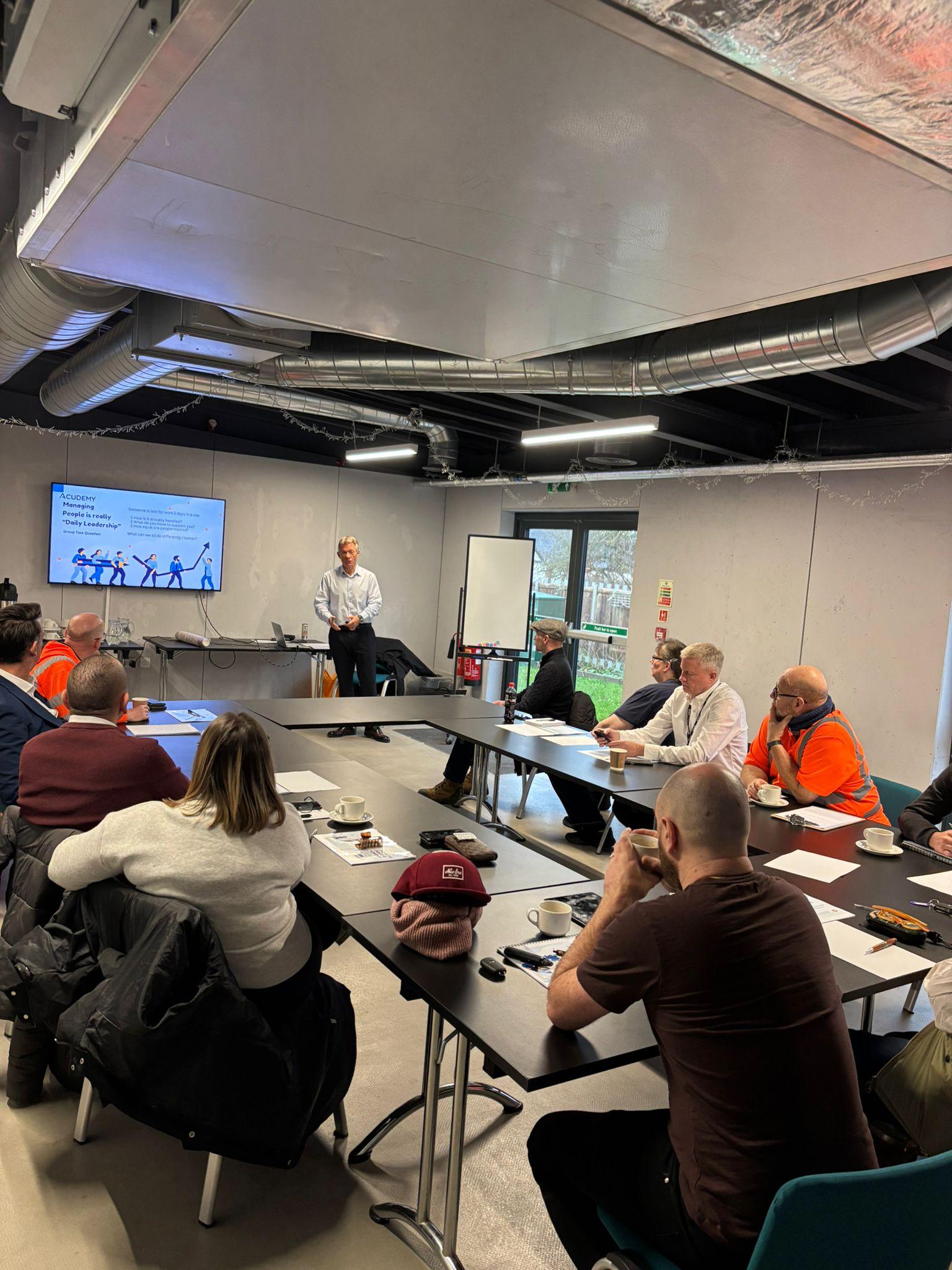
When Brentwood Borough Council and Rochford District Council came to Acudemy, they weren't looking for another off-the-shelf leadership course. They had already tried the market and found it wanting.
Generic leadership training felt too theoretical, too removed from the realities of a depot, and, in their words, too dull to engage the people who needed it most. So before we designed a single session, we asked a different question. Not "what leadership content should we deliver" but "what does leadership actually look like for someone managing a waste crew at 7am with a sick driver, a delayed vehicle and a route change all at once." EndFragment That question shaped everything that followed.
Starting with the brief, not the syllabus
The partnership gave us three clear requirements. The programme had to be practical, speaking to the realities of a depot rather than a boardroom. It had to be council specific, built around the partnership's actual HR policies and real scenarios their managers faced. And it had to be engaging, something operational managers would look forward to attending, not endure.
Most training providers start with a syllabus and adapt it. We started with the brief and built from there.
The partnership gave us three clear requirements. The programme had to be practical, speaking to the realities of a depot rather than a boardroom. It had to be council specific, built around the partnership's actual HR policies and real scenarios their managers faced. And it had to be engaging, something operational managers would look forward to attending, not endure.
Most training providers start with a syllabus and adapt it. We started with the brief and built from there.
Designing for how people actually learn on the job
Rather than compress leadership development into a single intensive workshop, we spaced six half day sessions across four months. This gave delegates time to apply what they learned between sessions, so the thinking embedded properly instead of fading within a fortnight, which is the usual fate of one off training days.
We also made a deliberate choice on who sat in the room together. Delegates spanned Operational Officer to Department Director, across both councils, learning side by side. That mix encouraged dialogue across functions and seniority that rarely happens in normal council life, and it meant supervisors weren't just being told what leadership looks like, they were hearing it debated by the people above them too.
Building the programme around real consequences, not theory
Each session built on the last, moving from foundational behaviours through to accountability and culture:
We started with the day to day fundamentals, the shift from "mate" to "manager" and applying policies fairly and consistently, giving delegates a five question Fairness Framework they could use immediately.
From there we moved into the harder territory, surfacing the behaviour issues that often go unspoken and structuring honest conversations using a four step model, tested through roleplay against real council scenarios rather than hypothetical ones.
We tackled prioritisation under genuine operational pressure, giving delegates a Task Matrix and a 10 Minute Daily Planner designed specifically for depot paced mornings, not office ones.
We addressed professionalism in a frontline context, from uniform and vehicles to how residents are treated and how a shift ends, using "professional or not" scenarios drawn from real situations.
We introduced a Handle, Monitor, Escalate framework to shift the question managers were asking themselves from "what's easiest right now" to "what happens next if I do nothing."
And we closed by building a learning culture, moving teams from dependency to responsibility, culminating in a Depot Leadership Charter the cohort wrote themselves, a set of shared commitments co owned across both councils rather than handed down from HR.
The result wasn't just a course. It was a working document.
Every delegate completed every session, a 100 percent attendance rate across a four month programme, which is rarely seen in operational teams pulled in a dozen directions daily. Every respondent said the course met their expectations. And most tellingly, the cohort left with a Charter they had built together, one that is still shaping day to day practice across both councils.
As Marcus Hotten, Director at Rochford District Council, put it: "By the end of the six sessions the cohort weren't just engaged, they were using the language, the frameworks and the Charter we built together in their day to day work."
That is the difference between training that gets delivered and training that gets used.
The same approach, applied to your teams
This programme was built for one partnership, but the method behind it isn't unique to councils in Essex. It's how we approach any organisation with a frontline leadership gap: understand the real environment first, design around genuine scenarios second, and build in the pacing that allows learning to stick.
If your organisation has supervisors who've stepped into people management without formal training, or a cultural divide between office based and operational teams, this is worth a conversation.
Ready to Showcase Your Training Expertise?
Join our marketplace and connect with organizations actively seeking training solutions. Showcase your expertise and grow your training business with qualified leads.