
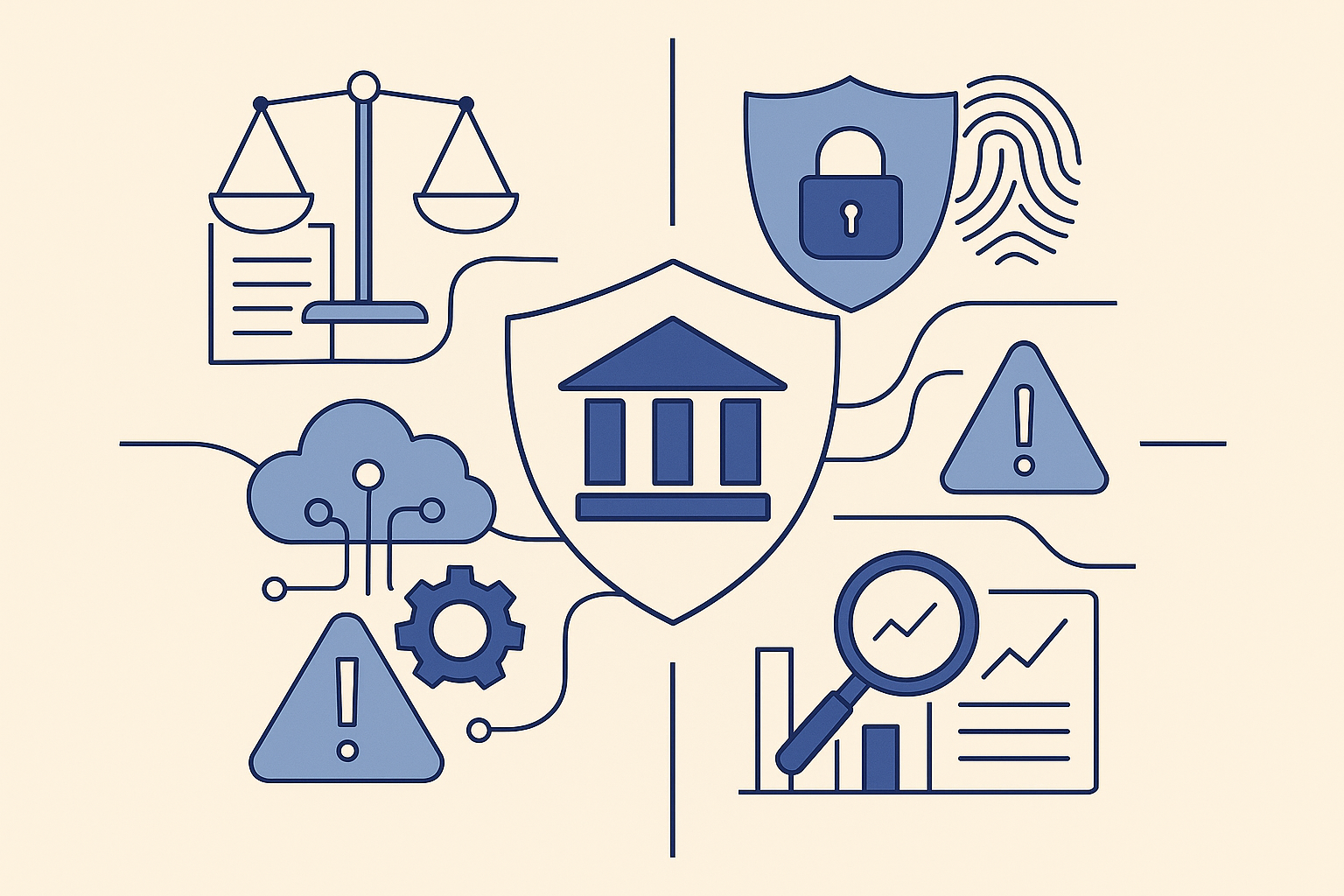
The banking industry today faces a gauntlet of challenges that are testing even the most established institutions. Rapid technological change, ever-thickening rulebooks, evolving risks, and relentless cyber threats form a formidable mix of pressures. In this third part of our series, we examine the biggest challenges in banking right now – focusing on four key areas: regulation, risk management, technology disruption, and cybersecurity. Understanding these challenges is the first step in developing strategies (including training strategies) to overcome them.
1. Navigating an Ever-Changing Regulatory Landscape
Regulation is the middle name of modern banking. Since the global financial crisis of 2008, regulators worldwide have dramatically tightened oversight of banks. While these rules are essential for stability and consumer protection, keeping up with them is a massive challenge for banks. Consider that globally, the number of regulatory changes banks must track has exploded – one study noted banks have to monitor an average of 200 regulatory revisions per day across jurisdictions . This includes new laws, amendments, guidance notes, and reporting requirements that never stop coming. Banks need whole teams (and robust software) just to stay on top of compliance.
In 2025, several regulatory trends are front and center. Capital and liquidity rules (like the final Basel III implementations, sometimes dubbed “Basel IV”) are raising the bar on how much loss-absorbing capital banks must hold. This can constrain lending if not managed carefully. Consumer protection and conduct regulations are also expanding – for instance, the UK and EU have introduced stricter rules to ensure fair treatment of customers and transparency in fees. Then there’s the push into new domains: regulators are increasingly focusing on operational resilience, meaning banks must prove they can withstand IT outages or other disruptions without harming customers. Environmental, Social, and Governance (ESG) regulations are emerging too, requiring banks to assess and report climate-related risks in their portfolios. And let’s not forget anti-money laundering (AML) and know-your-customer (KYC) requirements, which grow more complex as financial crime tactics evolve.
For banks, the challenge is not only understanding each new rule but also weaving compliance into day-to-day operations. Regulatory compliance has become extremely costly – global banks have spent hundreds of billions in fines for past compliance failures (about $321 billion since 2008, according to a BCG report) , and continue to invest heavily in compliance staff and systems to avoid future penalties. The complexity is especially tough for banks operating across multiple countries, who must juggle different (sometimes conflicting) regulatory regimes. A practical example: a bank might need to implement EU data privacy rules (GDPR) while also complying with U.S. anti-terrorism finance laws – two sets of requirements that can be hard to reconcile.
Regulatory uncertainty adds to the challenge. Rules can change with political winds. A new government might tighten bank regulations further (e.g. stricter consumer finance rules) or, conversely, consider loosening some requirements to spur lending – banks must be prepared for either. In the U.S., shifts in administration lead to different priorities for bank examiners (as seen with changes in 2025 supervisory priorities ). All this means banks must build agile compliance capabilities. They are responding by investing in “RegTech” – regulatory technology tools – to automate monitoring of transactions and reporting. They’re also upskilling their workforce: compliance training is now a core part of bankers’ professional development. From front-line staff being trained on treating customers fairly, to risk teams learning the minutiae of the latest capital rules, continuous learning is essential. Ultimately, regulation isn’t a one-time hurdle; it’s a continuous course that banks must run, and those that make compliance part of their culture will cope best.
2. Managing Risks Old and New
Banking is fundamentally a risk management business – and today those risks are manifold. Banks must contend with traditional risks (like credit risk, market risk, liquidity risk) in an environment that’s far from traditional, while also grappling with emerging risks that are still uncharted.
Take credit risk: with rising interest rates in many markets through 2023–2024, the cost of borrowing jumped. Some borrowers are struggling to repay loans taken during the previous low-rate era. For banks, this means carefully watching loan portfolios for signs of stress and higher defaults. We saw a dramatic example of interest rate risk mismanagement when Silicon Valley Bank in the U.S. collapsed in 2023 – it had over-invested in long-term bonds that fell in value when rates rose, wiping out its capital . That incident was a wake-up call globally that interest rate risk (a form of market risk) is very real after a long period of stable low rates. Banks now have to stress test their balance sheets against scenarios of inflation and rate volatility to ensure they won’t face the same fate.
Liquidity risk is another perennial concern: if too many customers suddenly withdraw funds, can the bank meet those demands? Even solvent banks can be brought down by a liquidity crunch (again, SVB is an example). Ensuring enough high-quality liquid assets on hand is a challenge especially when market conditions change quickly.
On the market risk side (trading and investment operations), 2025’s markets are volatile – geopolitical tensions, shifting yield curves, and currency fluctuations can all swing trading results. Banks have to balance seeking returns with keeping risks in check via limits and hedging strategies. There’s also operational risk – losses from failures in processes, people, or systems – which segues into the technology and cyber issues we’ll discuss shortly.
A big focus now is emerging risks such as climate-related risk. Banks are increasingly examining how climate change could affect their loan books (for example, loans to coastal real estate or carbon-intensive industries carry new long-term risks). Regulators in the UK and EU have even started to “stress test” banks on climate scenarios. Geopolitical risk is also heightened – sanctions, trade wars, even conflict can suddenly turn loans sour or freeze assets, as seen with sanctions on Russia affecting European banks in 2022.
Managing all these risks requires sophisticated models, but also sound judgment – hence banks are heavily investing in risk management training and talent. There’s high demand for risk analysts and officers who not only understand quantitative methods but also can think holistically about what-if scenarios. Indeed, many banks cite finding skilled risk professionals as a challenge in itself. The key is building a risk-aware culture where everyone from the CEO to the front-line lender understands the bank’s risk appetite and adheres to it. That involves clear communication and ongoing education about lessons from past incidents and new risk developments.
3. Tech Disruption and Digital Transformation
If one force has defined banking in the last decade, it’s technological change. The rise of fintech startups and digital innovation has been a double-edged sword for banks: on one side, huge opportunities to serve customers better; on the other, fierce competition and pressure to keep up. As of 2025, this challenge is more intense than ever.
Fintech competitors: Agile fintech companies have unbundled traditional banking services. There are fintech apps for payments, lending, wealth management – often providing slick user experiences that particularly attract younger customers. In the UK, digital challenger banks like Revolut, Monzo, and Starling gained millions of customers, forcing big banks to improve their own digital offerings. Globally, Big Tech firms also lurk at the edges of finance (imagine if Apple, Google or Amazon deepen their financial services – they’ve already launched credit cards and payment services). Banks worry about losing market share to these new players who aren’t burdened by legacy systems or branch networks. It’s telling that 40% of Brits now have an account with a digital-only bank – a sign that customers are willing to entrust newer tech-driven firms, not just traditional banks.
Digital customer expectations: Today’s customers expect banking to be as easy as texting, available 24/7, and personalised. This means banks must invest in seamless mobile apps, online platforms, AI chatbots for support, and data-driven personalisation. The challenge is huge, especially for incumbents that have decades-old IT systems. Many banks still run core banking software from the 1980s-90s – robust but inflexible. Integrating new tech (like mobile interfaces or open banking APIs) on top of these legacy cores is complex and costly. Banks risk falling behind if they can’t modernise quickly. For example, the implementation of Open Banking in the UK (which allows customers to securely share their banking data with third-party apps) forced banks to build new APIs and infrastructure or risk losing relevance in a more interconnected financial ecosystem.
Automation and AI: Internally, banks are racing to harness technologies like artificial intelligence, machine learning, and robotic process automation. These can drastically cut costs and improve accuracy – think AI-driven credit scoring, automated loan processing, or AI fraud detection systems scanning millions of transactions for anomalies. Gartner predicts a huge shift of IT spending to the cloud and AI in financial services by mid-decade . However, adopting these comes with headaches: selecting the right solutions, integrating them, and crucially, training staff to use them effectively. A UK study found a strong appetite among accountants (akin to bankers in this context) to upgrade AI skills, but only a quarter were receiving training from employers . We can imagine similar gaps in banking – having cutting-edge software is pointless if employees don’t know how to leverage it. Banks must upskill their teams even as they invest in new tech.
Core system upgrades and agility: Many banks are undergoing major IT transformation programs, even core system replacements, to become nimbler. But such projects often run over budget or hit snags, given the complexity and the need to keep the bank running while changing the engine. The challenge is not just technical but cultural: moving from a slow, siloed approach to an agile, innovative mindset. Banks historically were cautious and procedure-bound (for good reasons like safety), but now they need to foster innovation like a tech firm while still managing risk.
The opportunity side of tech disruption is that banks who get it right can greatly improve efficiency (lower cost-to-income ratios), reach new customers (for instance, via digital banking in markets where branches don’t exist), and create entirely new services (like digital asset custody or instant cross-border payments using blockchain). The pressure is on, though – technology’s clock speeds up every year. As one banking executive quipped, “We’re not just competing with other banks’ technology, we’re competing with everyone’s last best digital experience.” That might be an e-commerce checkout or a streaming app – if banking feels clunky by comparison, customers will be unhappy.
4. Battling Cybersecurity Threats and Fraud
In an era where “money” is often just an entry in a database, cybersecurity has become one of the most critical challenges for banks. Financial institutions are prime targets for cyber criminals – the rewards are high (steal money or valuable data) and the institutions are complex, sometimes offering many points of entry if not well-defended.
The scale of the threat is staggering. Banks face millions of cyber attacks or intrusion attempts every single day. Threats range from sophisticated hacking groups trying to penetrate networks, to social engineering scams tricking customers or employees, to malware and ransomware that can cripple systems. The cost of breaches is also rising. In 2024, the average cost of a data breach in the financial sector hit $6.08 million – higher than the cross-industry average, reflecting the premium on financial data . That figure includes everything from investigation and recovery to legal penalties and customer notifications. And it doesn’t fully capture the reputational damage – if a major bank suffers a high-profile hack and customer data leak, it can lose the trust of customers overnight.
Fraud is a closely related battlefront. Digital banking convenience sometimes comes at the cost of new fraud opportunities. As one chief risk officer noted, customers doing everything via their phones or email means banks have fewer face-to-face interactions, making impersonation and scams easier . Cyber fraud has become very sophisticated – from phishing emails that convincingly mimic bank communications, to fake “tech support” calls, to identity theft using data stolen in breaches. Even old-school fraud methods are resurging: cheque fraud (yes, physical cheques) has made a comeback in some regions , and authorised push payment (APP) fraud – where scammers trick people into sending them money – has grown so problematic that regulators stepped in (as mentioned, UK banks must reimburse victims up to £85k for certain scams ).
Banks are pouring resources into cybersecurity. It’s an arms race: as banks deploy better defenses, criminals up their game or find new angles. Key areas of focus include:
- Strengthening IT defenses: using advanced firewalls, intrusion detection systems, multi-factor authentication for customers, encryption of data, regular penetration testing of systems, and so on.
- Continuous monitoring: Many banks now have 24/7 security operations centers tracking any suspicious network activity. AI plays a role here, too, analyzing patterns to flag potential breaches or fraud in real time.
- Third-party risks: Banks increasingly rely on third-party providers (cloud services, fintech partners). This introduces another vulnerability – if the vendor has a weakness, it can be a way in. The sector is paying attention to vendor risk management; for instance, a corrupted software update from a vendor affected millions of systems in 2023 , a scenario that set off alarm bells for banks about the security of their supply chain.
- Employee and customer education: Humans are often the weakest link. A single employee clicking a malicious link or a customer divulging their password can bypass a lot of expensive tech. Banks therefore invest in training staff on cyber hygiene and running customer awareness campaigns (like those phishing text message warnings or partnership with governments on fraud alerts).
Cybersecurity is not a one-time fix; it requires constant vigilance and adaptation. The challenge for banks is also resource-related: recruiting skilled cybersecurity professionals is tough due to talent shortages. Many banks find themselves competing with tech companies for the same infosec experts. This is where training internally becomes important – upskilling IT staff or even re-skilling other staff into cyber roles to fill the gap.
The bottom line: cybersecurity and fraud prevention are now core banking activities. In bygone eras, a bank robbery involved a masked person with a gun; today it could be an anonymous hacker halfway around the world. Banks must protect not only the money but also the sensitive personal and financial data they hold. Any lapse can erode customer trust swiftly (and result in hefty regulatory fines too).
Turning Challenges into Opportunities
Reading about these challenges – regulatory overload, multifaceted risks, tech disruption, cyber threats – it might sound like doom and gloom. Indeed, banks that fail to address them could falter. But each challenge also presents opportunities for those banks (and their people) that rise to the occasion:
- A rigorous regulatory environment can be a competitive advantage if a bank builds superior compliance systems and trust – customers and investors may prefer a bank known for integrity and safety.
- Advanced risk management practices can not only prevent losses but also help banks identify profitable opportunities (for example, by understanding risks better, a bank might confidently lend in areas others avoid).
- Embracing technology can streamline operations and cut costs – many banks are finding that digital transformation, while hard, ends up making them more efficient and able to serve customers in new ways. Some are even partnering with fintechs to offer best-of-both-worlds services.
- Excelling in cybersecurity protects the bank and its clients, and can be a selling point (“your money is safer with us”). Banks that innovate in fraud detection (using AI, cross-bank data sharing through consortiums like FS-ISAC, etc.) are saving millions and keeping customers happier.
For L&D and HR professionals in banking, the breadth of these challenges highlights where to focus training and talent development:
- Regulation – ensure teams understand not just the letter of rules but the purpose, and cultivate a compliance mindset across the organisation.
- Risk management – develop specialists with deep expertise, but also train general staff to be aware of risks in their day-to-day decisions.
- Technology skills – invest in upskilling employees on new digital tools, data analytics, AI, etc. A bank’s tech is only as good as the people who use and manage it.
- Cyber awareness – implement regular training so every employee knows how to spot phishing or handle sensitive info. Also consider developing internal cybersecurity talent through certifications and courses.
The good news is that help is available. The Training Marketplace can support banks in addressing these challenges by connecting you with training experts and solutions tailored to the financial sector. Whether you need a crash course for your team on the latest banking regulations, a workshop on innovative fintech trends, or a hands-on cybersecurity simulation training, our platform can match you with vetted banking trainers who have specialised expertise in those areas. Simply outline your challenges to TaMi, our AI training concierge, and it will recommend targeted training options – for example, a programme to get your compliance team up to speed on new ESG reporting rules, or a cyber resilience course for your IT department. By investing in the right training, banks can equip their people to turn these daunting challenges into areas of strength.
Every challenge in banking ultimately comes down to having the knowledge, skills, and mindset to handle it. With continuous learning and the right partners, even the largest challenges can be met head-on – ensuring that your bank not only survives but thrives amid the headwinds of change.
Ready to Showcase Your Training Expertise?
Join our marketplace and connect with organizations actively seeking training solutions. Showcase your expertise and grow your training business with qualified leads.