
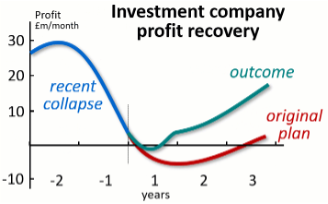
A fund management business faced collapse, after some years of successful and profitable growth. (These companies invest your cash in equities and bonds to grow your wealth, often through pensions or other investment products. They mostly sell those products through brokers or financial advisors).
How come?
Let the good times roll!
Business performance depends on the quality of resources that make it up – customers, staff, product range etc. – not just the scale of those resources (see here)
So sustained success depends on building and sustaining that quality (see here)
This investment company had made the mistake, while the economy was strong, of over-extending all of its resources:
It launched many new funds
… invested in a wider range of equities and bonds (its products)
… managed by an ever-growing number of analysts and fund managers
Those products were sold by an expanding sales-force
… to an ever larger numbers of brokers
… who signed up increasing numbers of investors
Sales grew strongly, bringing in a rising stream of investors’ wealth, and generating growing profits.
Then the going got tough.
We should all know that good times will likely end – and they sure did for this business. With a melt-down in the financial markets, the poor quality of all these assets came home.
Most of its funds’ values fell back
It didn’t know enough about the too-wide range of equities and bonds
The large teams of analysts and fund managers had too little experience
Few in the large sales-force were able to keep winning new business
Most of the brokers were too small and brought little new business
And it had accumulated many too-small investors.
The heavy costs of supporting all these low-quality assets far out-weighed the value they contributed and profits went into free-fall. The business was in real danger of termination!
What NOT to do!
Management reacted with the usual measures – cut spending budgets across the board, stop business class travel, cut contributions to staff pensions, cancel or defer IT projects … and so on.
Not only would these actions do nothing to fix the underlying problem, some would actually weaken the business still further. The IT plans, for example, would have made the business more effective and cut its operating costs!
“Prune” the plant!
Gardeners will be familiar with the benefits of pruning shrubs – removing dead or weak growth, so the plant’s strength gets focused on the stronger shoots.
In this case, that pruning meant closing down the low-quality portion of all of those poor resources.
The details of how exactly that was done are complicated and took quite some time to achieve. However, the end-result was a business less than half of its previous scale, but healthy and just about profitable. And – crucially – it was capable of renewed growth, but this time taking more care!
Model it!
The dangers in such cases are severe. Cut the wrong things, in the wrong order, or by the wrong degree and the whole system could collapse. (Staff are especially fragile – smart professionals such as you find in this type of business are highly mobile! The last thing you need is a rush for the exit by the key professionals you most need for the turn-round)
So before embarking on this or any other strategy or initiative, it’s a good idea to simulate its likely progress. Better still – model the future to work out the strategy in the first place, then use that same model to manage its progress, week to week.
(See here for more on digital-twin business models and how to build them)
Ready to Showcase Your Training Expertise?
Join our marketplace and connect with organizations actively seeking training solutions. Showcase your expertise and grow your training business with qualified leads.