
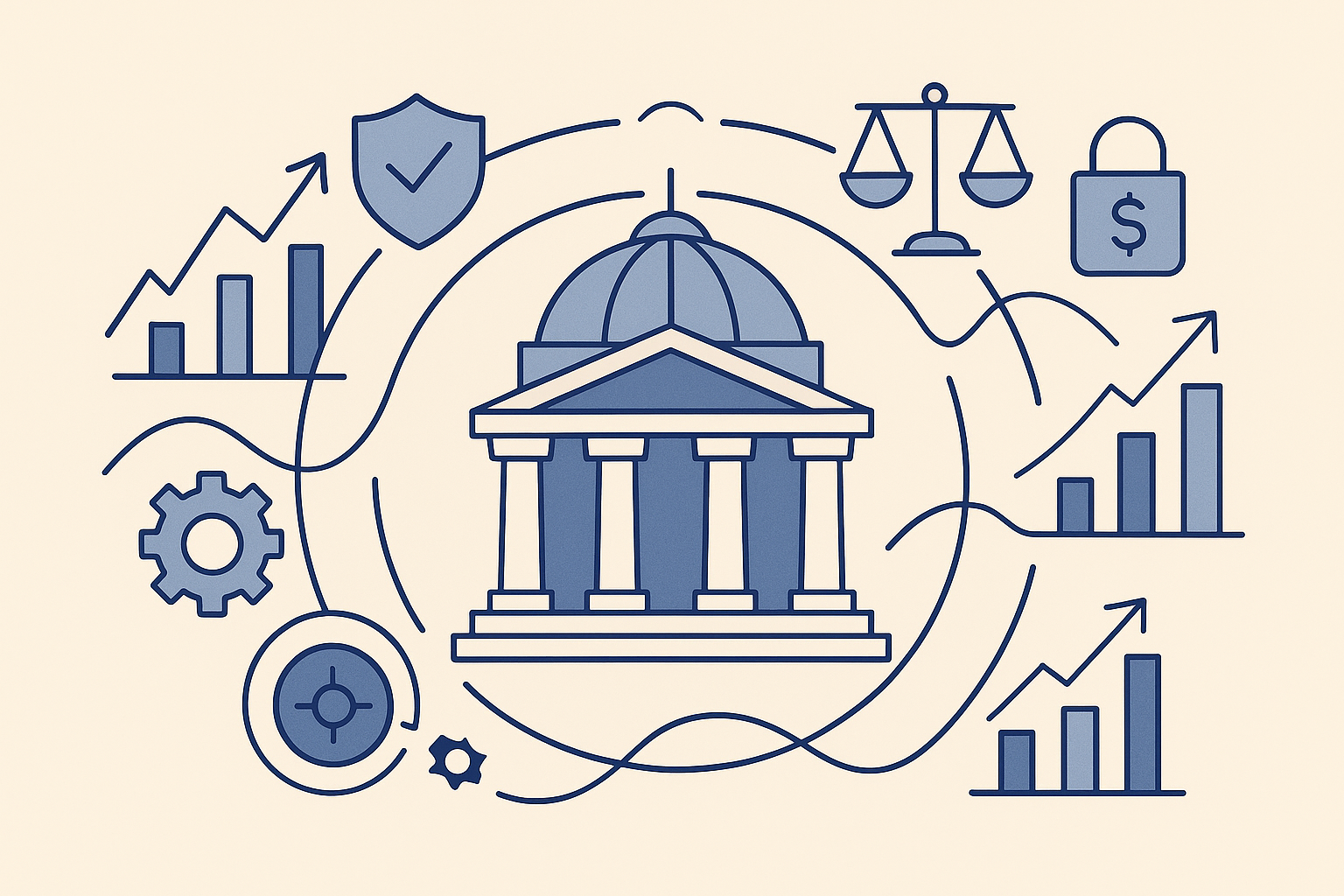
Banks are often likened to the heart of an economy, pumping money through the system to keep it healthy. But how exactly do banks accomplish this? In this article, we step inside the banking system to look at the pivotal roles banks play in driving economic growth, maintaining financial stability, and fostering public trust. Understanding these roles sheds light on why well-functioning banks are so vital to both prosperous economies and stable societies.
Fueling Economic Growth through Lending and Investment
One of the primary ways banks propel growth is by providing credit. Think of credit as the oxygen that businesses need to breathe and expand. Banks take money from savers (who might otherwise have left it idle) and lend it to those who can put it to productive use – a process that turns deposits into new factories, shops, and innovations. By serving as intermediaries between depositors and borrowers, banks mobilise savings and channel them into investments . This is crucial in any economy: it allows individuals to buy homes and cars, entrepreneurs to launch startups, and companies to invest in new projects and hire staff. When banks increase lending to the private sector, we often see a direct correlation with economic growth. For example, after the 2020 pandemic, bank loans helped many businesses weather the storm and later expand as the recovery took hold, thereby boosting employment.
Banks don’t just lend existing money; in a real sense, they create money through the lending process. Under the fractional-reserve system, a bank typically keeps only a fraction of deposits in reserve and lends out the rest, effectively multiplying the money supply. This ability to create credit means banks can amplify the impact of each pound deposited by reusing it for multiple loans (within prudent limits). The result is a multiplier effect – more funding available for businesses and consumers than if we relied solely on existing cash . Of course, this must be managed carefully to avoid too much debt, but when done responsibly it provides a powerful engine for growth.
Beyond lending, banks drive growth by facilitating payments and transactions. An efficient payments system is like the highway system of the economy, enabling the smooth flow of commerce. Banks operate the infrastructure that lets money move swiftly and safely – from card networks to electronic transfers and international trade finance. A well-operating payments network is a prerequisite for an efficient economy . Imagine trying to run a modern business if you could not quickly pay suppliers or receive customer payments – economic activity would slow dramatically. By handling millions of transactions every day, banks ensure that trade and commerce can happen at high speed, which in turn supports GDP growth.
Banks also support economic development through investment and advisory services. Many banks have investment banking divisions that help companies raise capital (via stocks or bonds) to fund expansion. They advise on mergers that can create more competitive firms, and facilitate infrastructure projects by arranging financing. In local communities, regional banks often play a hands-on role in development, financing new housing or municipal projects that create jobs. In short, banks at all levels, from community banks to global institutions, act as catalysts that turn financial resources into real economic outcomes.
Maintaining Stability in the Financial System
While fueling growth is one side of the coin, ensuring stability is the other crucial role of banks. A booming economy is of little use if it’s built on a shaky financial foundation that could collapse – as was learned painfully during banking crises. Banks contribute to stability in several ways:
- Risk Management: Banking involves taking calculated risks, but banks are expected to do so prudently. Over centuries, banks and regulators have developed sophisticated risk management practices. Banks diversify their loan portfolios across industries and regions to avoid over-concentration. They maintain capital buffers and liquidity reserves to absorb unexpected losses or withdrawals. They use models and stress tests to gauge how they’d cope with adverse scenarios (like a spike in interest rates or a recession). All these practices aim to keep individual banks stable so that their problems don’t spill over to the wider economy.
- Financial Shock Absorbers: Banks also act as shock absorbers during economic ups and downs. In good times, they build up provisions and reserves; in bad times, they can work with borrowers to restructure loans or provide new credit to struggling but viable firms, softening the blow of downturns. During the COVID-19 crisis, for instance, many banks offered payment holidays or emergency loans to businesses, supported by government guarantees – this banking system response helped prevent a cascade of defaults and layoffs. Additionally, central banks rely on the banking sector to transmit monetary policy: when interest rates are cut to stimulate growth, banks pass on those lower rates through cheaper loans, helping to stabilise the economy. In essence, banks are an integral part of the policy toolkit for managing economic cycles and crises.
- Prevention of Bank Runs: Historically, one of the gravest threats to financial stability was the bank run – a sudden loss of confidence leading depositors to withdraw funds en masse. Modern banking systems have safeguards to prevent runs. Regulation requires banks to keep a portion of deposits in highly liquid form. Deposit insurance schemes reassure customers that their money (up to a limit) is safe even if a bank fails. Central banks stand ready to lend to solvent banks in temporary trouble (the “lender of last resort” function). All these measures, combined with greater transparency, make outright bank runs far less common now. That said, confidence remains paramount – as banking experts note, banking is fundamentally a confidence business . A whisper of doubt can still cause instability, which is why maintaining trust (as we’ll discuss next) is inseparable from stability.
- Regulatory Oversight: Stability is also maintained through extensive bank regulation and supervision. After past crises (most notably 2008), regulations like Basel III significantly increased the capital and liquidity requirements for banks to ensure they can withstand shocks. Regulators conduct regular stress tests on major banks, require strict lending standards, and monitor everything from cybersecurity resilience to anti-money laundering controls. While regulations can be complex and burdensome, their purpose is to prevent individual bank issues from destabilising the entire system. In the UK, for example, the Bank of England’s Prudential Regulation Authority keeps a close eye on banks’ health. This oversight has paid off – during recent upheavals such as the pandemic and 2023’s interest rate turbulence, banks in the UK and Europe remained resilient, partly thanks to stronger capital buffers. Stability in banking doesn’t happen by accident; it’s the result of diligent risk management by banks and vigilant supervision by authorities.
Fostering Trust and Confidence
If there’s one product that banks absolutely must “sell,” it is trust. People entrust banks with their life savings, and companies trust banks to safeguard operating funds and facilitate critical transactions. That trust is hard-earned and, if lost, very hard to regain. Banks drive public trust in the financial system through their everyday actions and commitments to customers:
- Safeguarding Deposits: The most basic trust-building role is that banks keep your money safe and accessible. Unlike hiding cash under a mattress, depositing in a bank ensures your funds are secure from theft or loss, and (thanks to deposit insurance) even protected if the bank encounters problems. Knowing that you can withdraw your money on demand, or that your debit card will work when buying groceries, is a cornerstone of trust. Banks devote enormous effort to security – both physical (vaults, secure cash transit) and digital (encryption, fraud monitoring) – so that customers can sleep at night.
- Honoring Commitments: Trust also comes from consistent, reliable service. When you schedule a payment, you trust the bank to send it on time. When your employer transmits payroll, they trust employees’ accounts will be credited correctly. This reliability is part of why long-established banks have built up strong public confidence over decades (despite occasional scandals). Even newer fintech banks must demonstrate they can be dependable. Many surveys indicate that people still place significant trust in their primary banks compared to other institutions, because of this track record of reliability. Of course, missteps can erode trust – which is why banks now prioritise customer transparency and fairness (no surprise hidden fees, clear communication). Modern consumers expect ethical behavior and responsiveness from banks, and meeting those expectations is key to retaining trust.
- Handling Crises Responsively: How banks behave in tough times greatly influences trust. Take, for example, the aftermath of the 2008 crisis: public trust in banks plummeted due to perceptions of reckless behavior. It has taken years of reforms and cultural change for banks to start regaining that trust. Conversely, consider a more recent scenario: in 2023, when a few U.S. regional banks struggled (like the high-profile collapse of Silicon Valley Bank due to mismanaged interest rate risk), regulators and larger banks stepped in quickly to contain the fallout . Swift action helped reassure depositors elsewhere that their funds were safe. In the UK, new rules even require banks to reimburse customers who are victims of certain fraud scams up to £85,000 – a move aimed at reinforcing customers’ confidence that their bank will protect them. By proactively protecting customers and swiftly addressing issues, banks (and regulators) show they deserve the public’s trust.
- Community and Ethical Commitments: Trust isn’t only about financial safety; it’s also about a sense that banks act in the broader interest of their communities. Modern banks invest in social initiatives, from financial literacy programs to charitable sponsorships, which can strengthen their relationship with the public. Importantly, ethical banking practices – such as lending responsibly, avoiding financing harmful industries, and treating customers fairly – contribute to reputational trust. A bank that consistently demonstrates integrity will earn loyal customers who trust it not just with money but with their financial well-being.
In summary, banks drive economic growth, stability, and trust in tandem. These three roles reinforce each other: by financing growth responsibly, banks strengthen the economy without undermining stability; by maintaining stability, they uphold the trust that encourages people to keep money in the system, which in turn allows more growth. When any of these pillars falter – if banks stop lending, or a crisis shakes stability, or public trust erodes – the consequences feed into each other negatively. That’s why healthy banking is such a focus for policymakers and why training competent banking professionals is so essential.
The Human Element – Why L&D Matters Here
For Learning & Development (L&D) professionals and banking leaders, understanding these core roles of banks is more than academic. It highlights which competencies bank employees need. To fuel economic growth, bankers need strong credit analysis skills and knowledge of markets. To maintain stability, they require risk management expertise and regulatory knowledge. To foster trust, they must have excellent customer service, ethics and communication skills. Building these skills is an ongoing process in every bank. Many banks invest heavily in training programs: from graduate schemes that teach fundamentals of lending and compliance, to continuous professional education on the latest cybersecurity practices or regulatory updates. By ensuring staff are knowledgeable and adaptable, banks better fulfill their crucial roles.
In fact, a well-trained banking workforce can turn these roles into competitive advantages. For example, a bank that trains its team in advanced data analytics might identify credit risks or market opportunities faster, driving growth with stability. Or a bank that upskills its customer-facing staff in empathy and problem-solving may build superior trust and satisfaction among clients. This is where The Training Marketplace can be a valuable ally. We connect banks and financial institutions with vetted banking trainers and consultants who specialise in all these critical areas – be it a course on financial analysis, a workshop on regulatory compliance, or a program on customer relationship skills. You can even describe your specific goals or pain points to TaMi, The Training Marketplace’s intelligent AI assistant, and get matched with a tailored training solution to strengthen your team.
By leveraging expert-led training, banks ensure their employees have the up-to-date knowledge and skills to drive growth safely, uphold stability, and maintain the trust of the public. Remember, you don’t have to tackle these challenges alone – resources like The Training Marketplace are here to help build the banking capabilities needed to succeed in today’s fast-moving financial landscape.
Ready to Showcase Your Training Expertise?
Join our marketplace and connect with organizations actively seeking training solutions. Showcase your expertise and grow your training business with qualified leads.