
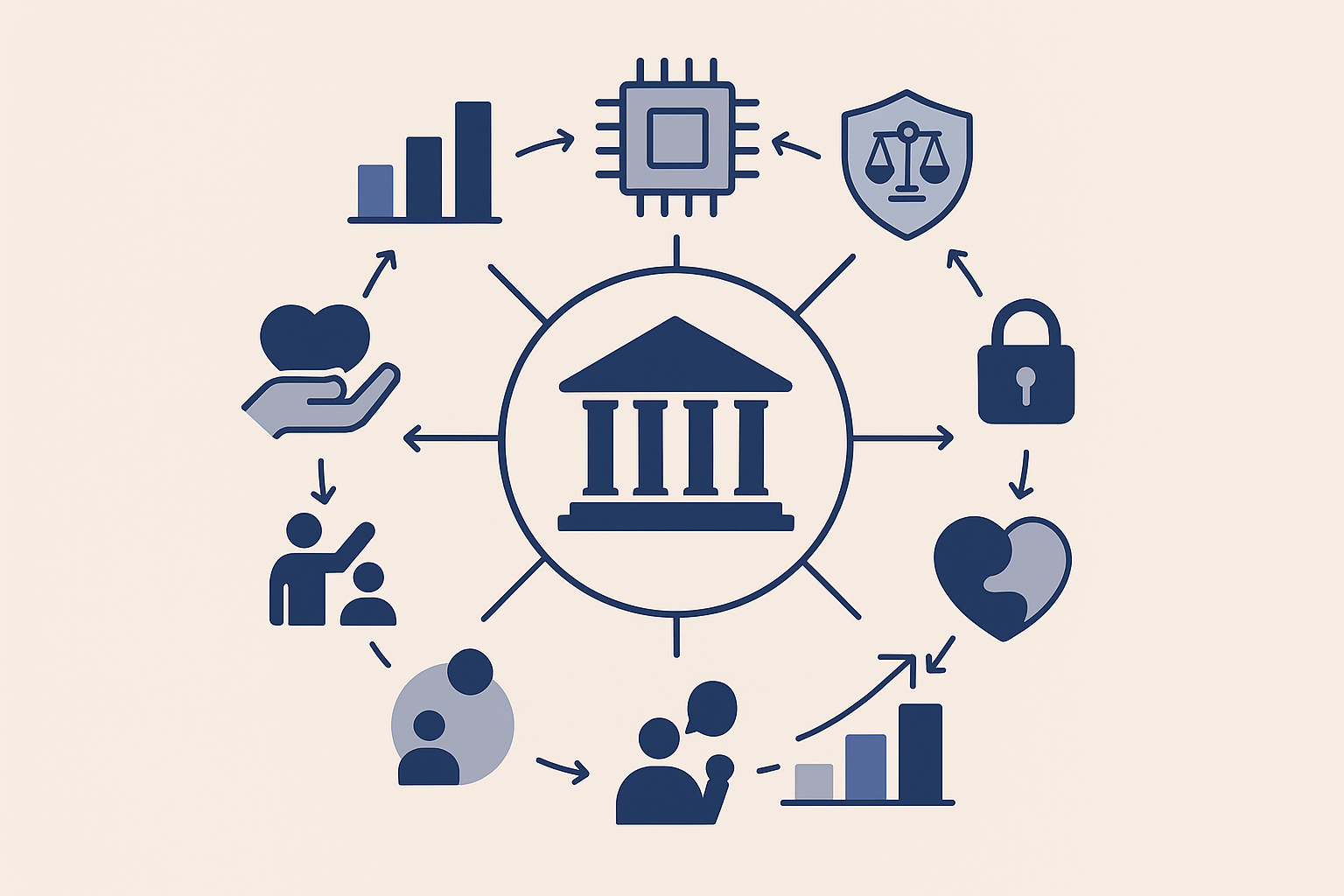
A bank is only as good as its people. In a time of fast-changing technology, evolving regulations, and intense competition, the talent within banking will determine which institutions lead and which lag. This fourth part of our series focuses on how Learning & Development (L&D) teams and HR leaders in banks can build the banking talent of the future. What essential skills should you be cultivating in your workforce to navigate the future of financial services? And how can targeted training and development programs close critical skill gaps? We’ll explore the key skill domains – from digital savvy to risk acumen to customer excellence – that banking professionals need to excel in the years ahead.
The Changing Profile of Banking Professionals
Traditionally, a career banker was someone with strong finance knowledge, perhaps a degree in economics or accounting, climbing the ranks through a mix of on-the-job experience and formal banking exams. Those fundamentals still matter, but the profile of an ideal banking professional in the future is notably broader. Banks are looking for “T-shaped” talent – deep expertise in certain areas plus the ability to collaborate across disciplines and adapt to new challenges. Why? Because the jobs in banking are changing:
- Automation is handling more of the routine work (like basic transaction processing or reconciliation), so human roles are shifting towards analysis, advisory, and creative problem-solving.
- Banks are becoming as much technology companies as financial ones, so even non-IT staff are expected to be comfortable with digital tools and data-driven decision making.
- Regulatory and societal expectations mean bankers need stronger ethical judgement and communication skills to maintain trust and navigate complex issues.
- The competitive landscape (fintechs, etc.) means banks need innovators and people who can drive change from within, not just do things “the way they’ve always been done.”
In short, the banking team of the future will include a more diverse mix of skills – combining financial expertise with tech fluency, risk awareness, interpersonal skills, and more. Let’s break down some of the essential skill areas that L&D should focus on:
1. Digital and Technological Fluency
It’s hard to overstate the importance of tech skills in banking now. As banks undergo digital transformation, every role is touched by technology. Key skills under this umbrella include:
- Data analysis and analytics: Bankers increasingly need to interpret data, whether it’s a relationship manager analyzing customer spending patterns or a compliance officer reviewing transaction data for anomalies. Familiarity with tools like Excel (advanced), SQL, or even Python for data analysis is becoming valuable. Understanding data visualisation to communicate insights is also a plus.
- AI and machine learning basics: While not everyone will be a data scientist, banking staff should understand what AI can do and how to use AI-driven tools. For instance, credit analysts might use AI credit scoring models – they should know how they work conceptually and their limitations. According to the UK Financial Services Skills Commission, 75% of financial firms were already using AI by 2024, but 81% flagged a lack of specialist AI talent as a barrier to fully leveraging it . This indicates a big training need – upskilling current staff on AI concepts to bridge that gap.
- Digital literacy: Comfort with a range of software and systems, from core banking systems to CRM platforms to mobile apps. It’s not just IT staff – even branch personnel now need to guide customers on using online banking, for example.
- Cybersecurity awareness (for all): Given the stakes, every employee must be a mini “cyber guardian.” Skills here mean being able to spot phishing attempts, use secure practices (strong passwords, etc.), and generally maintain good IT hygiene. Many banks run mandatory e-learning modules or workshops on cybersecurity for all staff. Some are even training branch staff to educate customers about scams as part of customer service – merging communication skill with cyber knowledge.
For L&D departments, developing digital fluency might involve a combination of formal training (courses on data analytics, AI, etc.), encouraging certifications (like a certificate in fintech or data science for finance), and creating more opportunities for employees to work on tech-related projects internally to gain experience. Mentoring can help too – pairing tech-savvy team members with those less comfortable.
2. Risk Management and Compliance Skills
As we discussed in the challenges section, risk and regulation loom large in banking. Thus, a core skill set needed is the ability to understand and manage risk, and to navigate complex compliance requirements. This isn’t just for those with “Risk” or “Compliance” in their title; a culture of risk awareness across the organisation is crucial.
Key skills and knowledge areas include:
- Regulatory knowledge: Keeping up with banking regulations (credit policies, consumer protection rules, AML/KYC procedures, data privacy laws, etc.). Front-line employees, for instance, should be well-versed in anti-fraud and KYC procedures so they can do proper checks and spot red flags. L&D can support this through regular compliance refreshers and gamified learning (to keep what can be dry content more engaging).
- Risk assessment and decision-making: For managers and analysts – being able to assess the risk/reward of a loan, an investment, or a new product. This involves quantitative skills (understanding risk models, reading risk reports) as well as qualitative judgement (what does an evolving situation mean for our risk exposure?). Training might include case studies of past risk management failures and successes to draw lessons.
- Operational risk and resilience: An emerging skill area is operational resilience – understanding how to ensure processes continue under stress. This might involve scenario planning and incident management skills (like how to respond if a key system goes down). Some banks are instituting simulation exercises (drills) for their teams to practice responding to disruptions, akin to fire drills but for cyber/operational incidents.
- Ethics and integrity: A softer but vital skill – making ethical decisions. This goes hand-in-hand with compliance. Banks are emphasising conduct training so that employees internalise principles like treating customers fairly, speaking up if something seems wrong, and considering reputational risk in their actions. Often, this is imparted through workshops on ethical dilemmas, or bringing real examples of ethical breaches to discuss how to avoid them.
By strengthening risk and compliance skills, banks not only avoid costly mistakes but also empower employees to act confidently within clear guidelines. The Financial Services Skills Commission reported that the UK finance sector still has the highest share of hard-to-fill roles, reflecting ongoing challenges in accessing skilled talent – particularly in specialist areas like risk and compliance. This puts onus on developing talent internally to fill those gaps.
3. Customer Experience and Relationship Management
Even in an age of automation, banking remains a people business. Whether it’s retail banking or corporate banking, building trust and providing excellent service to customers is paramount. Thus, banks highly value skills related to customer experience:
- Communication and interpersonal skills: The ability to explain financial concepts clearly to clients, to listen and understand their needs, and to build rapport. For example, relationship managers and financial advisors need to translate complex banking products or market movements into plain language. They also need empathy – understanding a client’s goals or anxieties. Training in active listening, clarity in writing and speaking, and even cross-cultural communication (for global roles) can be very beneficial.
- Sales and advisory skills: Modern banking sales are consultative rather than hard-sell. Staff need to identify customer needs and suggest suitable solutions, which requires product knowledge and a consultative approach. Upskilling in this area might include role-playing exercises where, say, a branch banker practices uncovering a customer’s life goals and recommending appropriate financial products, rather than just pushing whatever the product of the month is.
- Customer-centric innovation: Encouraging employees to think from the customer’s perspective and even contribute ideas to improve services. For instance, some banks train their teams in journey mapping – analyzing the steps a customer goes through for a given service – to spot pain points and brainstorm improvements. This blends creative thinking with empathy.
- Handling difficult conversations: Inevitably, there are times when bankers must handle complaints or deliver bad news (like a loan denial). Skill in de-escalation, maintaining professionalism, and problem-solving under pressure is crucial. Scenario-based training can prepare staff for these challenging interactions.
Banks are increasingly measuring success not just in revenue, but in customer satisfaction (Net Promoter Score, etc.). So the human touch can be a differentiator even as a lot of routine interactions go digital. L&D can help instill a customer-first mindset through storytelling (e.g., sharing success stories of how excellent service deepened a client relationship) and by reinforcing that every role, even back-office ones, ultimately serves an end-customer.
4. Adaptive and Innovative Mindset
Given how fast banking is changing, one of the most important “skills” is actually a mindset: adaptability and continuous learning. Banks need employees who are not only willing but eager to update their skills and who can navigate change without being paralysed by it.
Key aspects here:
- Continuous learning skills: Teaching staff how to learn effectively on the job. This could involve time management for juggling work and learning, using digital learning resources, or peer learning groups. If employees see learning as part of their routine, the organisation becomes more agile.
- Problem-solving and critical thinking: Instead of following checklists blindly, employees who can think critically will be able to handle novel situations that arise. This can be fostered by giving teams real-world problem scenarios to solve in training sessions (for example, “Our competitor just launched a new app feature that we lack, how could we respond?” and have cross-functional groups discuss).
- Innovation and change leadership: Not everyone will be designing new fintech apps, but at least at the middle and senior levels, banks benefit from employees who can drive change. Offering training in innovation methodologies (like design thinking, agile project management) can equip staff to contribute to transformation projects. Similarly, change management training helps leaders guide their teams through transitions smoothly.
- Collaboration and cross-functional working: Breaking silos is a big theme in modern banks. Skills in working effectively in diverse teams, often remotely or across different departments, are essential. This can be developed through team-based learning activities and projects that force collaboration outside one’s comfort zone.
The good news is that many banking professionals are hungry to develop. A survey in the UK found financial services firms increasingly embedding skills development into strategy, and training spend being roughly split 50/50 between technical skills and “behaviours” (soft skills) . This balance shows recognition that soft skills and adaptability are as critical as technical know-how. Banks are also getting creative – some have launched internal “academies” or innovation labs to foster these abilities, and others partner with external providers for fresh perspectives.
5. Domain-Specific Expertise (as needed)
Of course, we shouldn’t ignore the specialist technical skills that certain banking roles require. For instance:
- Financial analytics and modelling: For roles in treasury, finance, or risk, advanced skills in financial modelling (e.g., DCF, stress testing models) and tools like Python, R or MATLAB for quantitative analysis are highly valued.
- Product and domain expertise: A trade finance officer needs deep knowledge of international trade instruments, a wealth manager needs expertise in investment products, etc. Continuous professional education (getting certifications like CFA, FRM, or industry-specific diplomas) often plays a part here.
- Regulatory certifications: In many cases, roles require certifications – e.g., in the UK, investment advisors take CISI exams, risk managers might pursue PRMIA or GARP certifications. Support and encouragement to attain these is part of building talent.
However, one person can’t be an expert in everything, which is why creating well-rounded teams is crucial. A future-ready bank will have a mix of experts (the deep “I” shape skills) who are supported by colleagues with bridging skills (the horizontal part of the “T” – those who can connect disciplines). L&D’s role is to fill common gaps and ensure knowledge sharing so that, for example, your tech people understand banking basics and your bankers understand enough tech basics to converse – fostering effective collaboration.
How to Develop These Skills: L&D Strategies
To develop this array of skills, banks are employing multiple strategies:
- Structured Training Programs: Many banks have graduate programs or rotational programs that expose newcomers to different areas to build a broad base. For existing staff, structured paths (like leadership development programs or data upskilling programs) help target specific skill sets for specific groups.
- On-the-job Learning and Mentoring: Encouraging mentoring – e.g., pairing a seasoned risk manager with a younger tech-oriented hire so they exchange knowledge. Also using job rotations or project assignments to help staff gain experience beyond their silo.
- E-learning and Microlearning: Given time constraints in banking, bite-sized online modules are popular for topics like compliance refreshers or new software training. These can be taken at the learner’s convenience.
- External Courses & Certifications: Partnering with external training providers (like those on The Training Marketplace) to deliver courses that the bank may not have in-house expertise for – such as an AI bootcamp for bankers, or an intensive course on the latest regulatory changes. The advantage of external experts is they bring outside best practices and a fresh perspective.
- Incentives and Culture: Finally, banks are trying to build a culture that values learning. Some have tied part of performance evaluations to skill development or encourage employees to spend a certain number of hours per month on learning activities. Recognition programs for completing certifications or contributing to knowledge-sharing can motivate staff to take learning seriously.
As an L&D professional or decision-maker, you might feel overwhelmed by the breadth of skills needed. Prioritisation is key – often aligned with the bank’s strategy. For instance, if your bank is pushing a big digital strategy, then focus on tech and data skills first. If you’re expanding into new markets, maybe focus on cross-cultural communication and international regulations. Use a Training Needs Analysis to pinpoint gaps. Also, consider the generational mix – as older employees retire (taking traditional relationship skills with them) and younger digital-native employees join (bringing tech savvy but perhaps less business context), tailor programs to encourage mutual learning between generations.
Partnering to Build Talent
It’s worth noting that you don’t have to do all this alone. The Training Marketplace’s global network of verified banking trainers is at your disposal to supplement your in-house efforts. Whether you need an expert to run a workshop on advanced credit risk techniques, a soft-skills coach to train your managers in leading hybrid teams, or a comprehensive talent development program for emerging leaders, you can find qualified providers through our platform. TaMi, our AI training assistant, makes this easy: you can specify the skills you’re targeting (say, “we need training on fintech and digital innovation for our retail banking team” or “looking for a program to develop high-potential women leaders in our bank”) and TaMi will recommend tailored solutions.
The future of banking will be written by those institutions that invest in their people. By developing the essential skills outlined above, you ensure your bank’s workforce is resilient, adaptable, and equipped to seize new opportunities. In a sector where competitive advantage often comes down to human judgment and service, building world-class banking talent is arguably the best investment your organisation can make.
Ready to Showcase Your Training Expertise?
Join our marketplace and connect with organizations actively seeking training solutions. Showcase your expertise and grow your training business with qualified leads.